Highlights: Nakayama lemma, snake lemma, tensor product, flatness
Define . It has an -module structure. The construction is “functorial”, namely. If is a homomorphism, then it deduces a homomorphism
Similarly, given , it induces a homomorphism .
Example. Compute . Since is divisible by , there is . It deduces that .
Easy Facts.
- For ideal , define is a submodule. When , write .
Definition
For submodules , define an ideal. Denote annihilator of as . Note as an -module can also be regarded as an -module. Say is a faithful -module if .
Proposition
is a finitely generated -module iff there exists an surjective iff is a quotient module of .
Nakayama Lemma
Proposition
Suppose is a finitely generated -module, and is an ideal. Let be an endomorphism such that . Then satisfies an equation of form
on for some , namely, for all .
Example. Let and . Define by . Then by Cayley-Hamilton, .
\begin{proof}
Choose a set of generators of . Then for some . Let be the characteristic polynomial of , then by Cayley-Hamilton.
\end{proof}
Corollary
Let be a finitely generated -module, and let be an ideal of with . Then there exists such that .
\begin{proof}
Let . By ^41223f, satisfies
on with . Let , then .
\end{proof}
Nakayama lemma
Let be a finitely generated -module, and let be an ideal with . If , then .
\begin{proof}
By ^d05ae0 there exists with such that . By ^h2e8bp, and so .
\end{proof}
Remark. The most useful situation is when is a local ring with . ^c2a5d0 tells if is finitely generated and , then .
Corollary
Let be a finitely generated -module with submodule . Let be an ideal. Then yields that .
\begin{proof}
Apply ^c2a5d0 to . Since , there is and then . Therefore, .
\end{proof}
Proposition
Let be a local ring. Let . Let be a finitely generated -module, then is a vector space over . Let . Suppose is a basis of , then generate .
\begin{proof}
Let . Then the composite is surjective. It deduces that . By ^ffbd3c, and so generate .
\end{proof}
Remark. This is quite similar to ^k9gxk1—in fact, the Jacobson radical can be seen as an analogue of the Frattini subgroup, but in the setting of rings instead of groups.
Exact Sequence
Link to original
- If is exact, then we say it is short exact.
Remark. Any exact sequence can be split into short exact sequences. Namely, given
then we get and , where .
Hom Functor
Proposition
- Let be a sequence of -module homomorphism. Then it is exact iff for any -module , the induced sequence
is exact, where and .
- (dual statement) Let be a sequence. It is exact iff for any -module , the induced sequence
is exact.
\begin{proof}
i) "→" Assume is exact. It is enough to show is injective and . If , then is zero. But is surjective, then . Note that as , and it deduces that . Conversely, for any , we aim to find such that . For , let and set . We can verify that is well-defined and is a homomorphism of -modules. Hence .
"←" It suffices to show is surjective and . If is not surjective, then let and apply to , that is,
is exact. The surjective map is a non-zero map, but is a zero map, which is a contradiction. Hence is surjective.
Take and . Then is exact yields that and so . Finally, we check . Now we take and
is exact. Define canonical map . Notice that , then . Then there exists such that . It deduces that and . Now we finish the proof.
ii) "→" Assume that is exact. It is enough to show is injective and . If , then . Since is injective, we have and so is injective. Note that as , so . For any , we aim to find such that . For any , define . Since and is injective, is well-defined and . Hence .
"←" Assume that is exact. It suffices to show is injective and . If is not injective, then . Let and apply it to . The inclusion map is included in and , which contradicts with injective. Take and satisfies , that is, . Conversely, take and
is exact. Since is an element of and , there is and so there exists such that . Then for any , we have and . Now we finish the proof.
\end{proof}
Remark.
- "" in is necessary. For example, consider is exact but right exact. Then .
- "" on LHS of is useless, as it cannot add "" to . Consider . Apply , then is only left exact.
Snake Lemma
snake lemma
Consider a commutative diagram where both rows are short exact.
Then we have an exact sequence
\begin{proof}
Notice that are restriction of . We can check that and induce maps and . So it suffices to construct . For any , take and so . Then define such that and is what we desire. It is easy to check this map is well-defined.
It remains to check the sequence is exact. For convenience, define
For any , there exists such that . By the definition of , we know and so . It deduces that . Conversely, for any , there exists such that . By the definition of , there is and . Thus . Now we have proved .
For any , there is and so for any given preimage . Then there is such that . By the definition of , we know . In addition, since , . It yields that . Conversely, for any , there exists such that and such that and for any given . By the definition of , there is and so , . Now we have proved .
\end{proof}
Remark. It is a general case of short five lemma.
Tensor Product
Motivations.
- linear algebra: bilinear map
- algebraic geometry: fibre product of geometry spaces
- flatness: useful for localization
Linear algebra. Let be a field. Notice that bilinear map and linear map are different.
- Consider bilinear map . It is different from -linear map , because and .
- Define , which is linear but not bilinear.
- A -linear map is determined by and ; a -bilinear map is determined by .
- A -bilinear map looks like a -linear map , as we will see .
Algebraic geometry. Note a fact that . Hence, . By ^6rh0cw, the set of maximal ideal of is . In fact, .
Flatness. Consider -bilinear map , which is determined by . Note that , then . In summary, the above bilinear map is same as a -linear map . Later we will see .
Definition
Let be a ring, and let be -modules. A map is -bilinear if .
Proposition
Let and be -modules. Then there exists a pair where is an -module and is an -bilinear map, with the universal property: Given any -module , and any -bilinear map , there exists unique -linear map such that , that is, factors through .
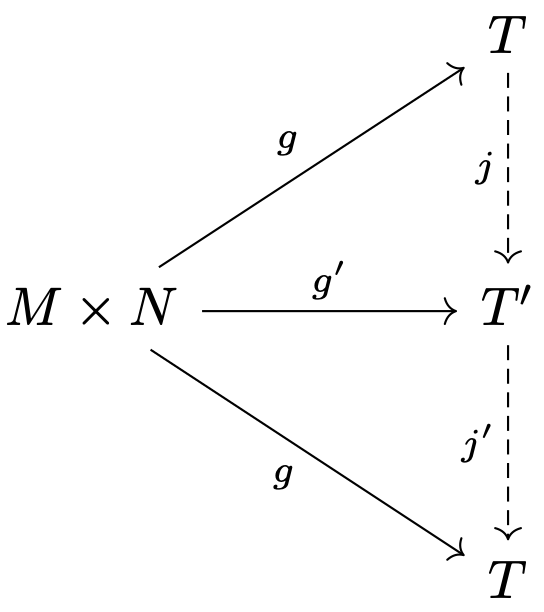
Moreover if and are two such pairs with above property, then there exists unique isomorphism such that .
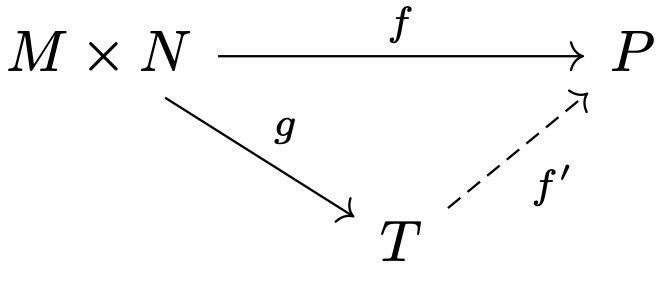
\begin{proof}
Uniqueness. Suppose and are two distinct pairs with the property above. Apply with and with , then there exist and such that .
Existence. Let be the free -module , namely, a free -module with basis . So an element in has unique expression . Let be the submodule of generated by the following elements:
- ,
- ,
- ,
- .
Let . For , denote as image in . Thus, is generated by . Now define
which is a -bilinear map. We now verify the universal property. Let be a bilinear map. It suffices to construct such that . We define , and we can easily see . So induces a map . Remark that
and so . Hence, for each bilinear map , we can find such that and so is what we desire.
\end{proof}
Definition
Call the module above as the tensor product of and , also denote as . Sometimes, just if the context is clear. Also the map is simply . In particular, the -module is generated by . Indeed, if generates and generates , then generates .
Remark. Not all elements of is of the form . In other word, is in general not surjective. For example, let and , then cannot equal to some with and .
Proposition
Let be -modules. Then there exists unique isomorphisms:
- such that ;
- ;
- ;
- such that .
\begin{proof}
i) Consider and . By ^aa5afc, there exists unique such that the diagram commutes.
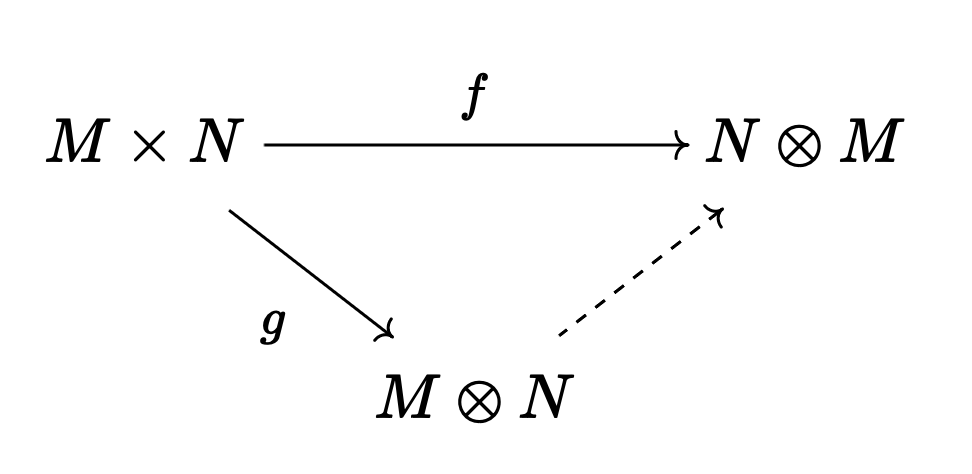
Now, in a parallel way, use the universal property of , then we get such that the diagram commutes.
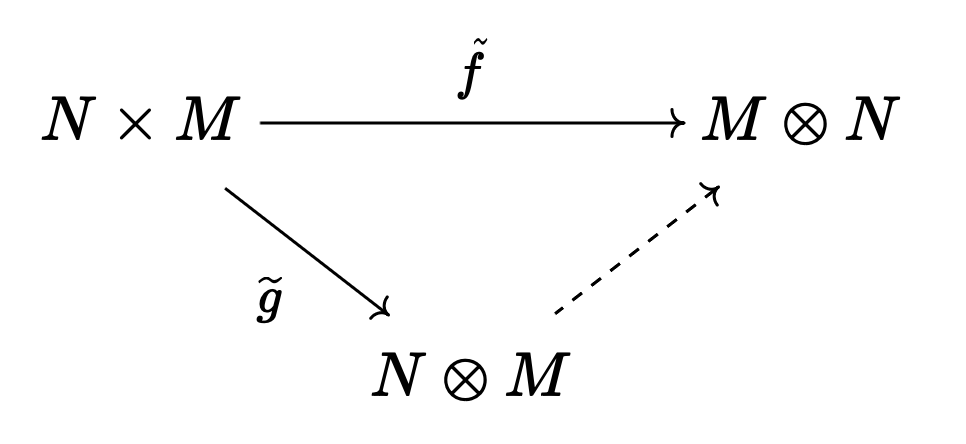
It is easy to check and are inverse to each other.
iv) Consider
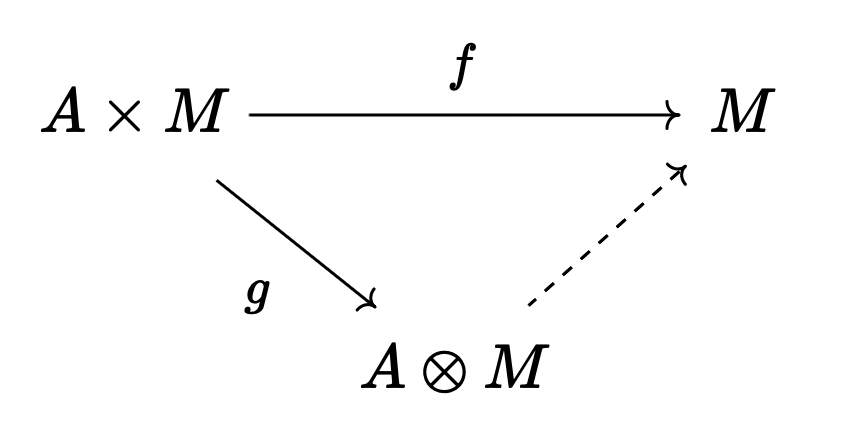
where , then there exists unique such that the diagram commutes. Now define . To check and are inverse to each other, it suffices to check .
Recall the proof of ^aa5afc, let be the free -module and be the -submodule generated by , , and . Let , and let . So we must have
which yields and so .
\end{proof}
Proposition
Let be -module. Then there exists where is a multilinear map such that for any -module and multilinear map , there exists unique such that the diagram commutes.
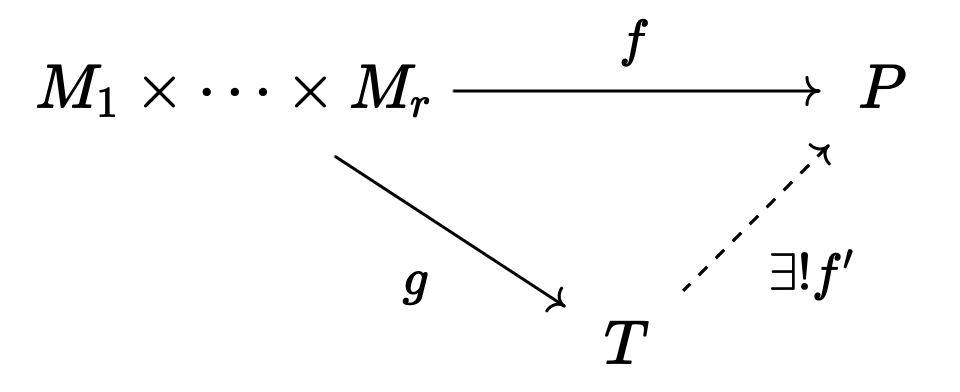
\begin{proof}
Similar to ^aa5afc.
\end{proof}
Strange Things about Tensor Product
Consider and , then is submodule. However, it could happen is not injective. Use the following diagram to define the map.
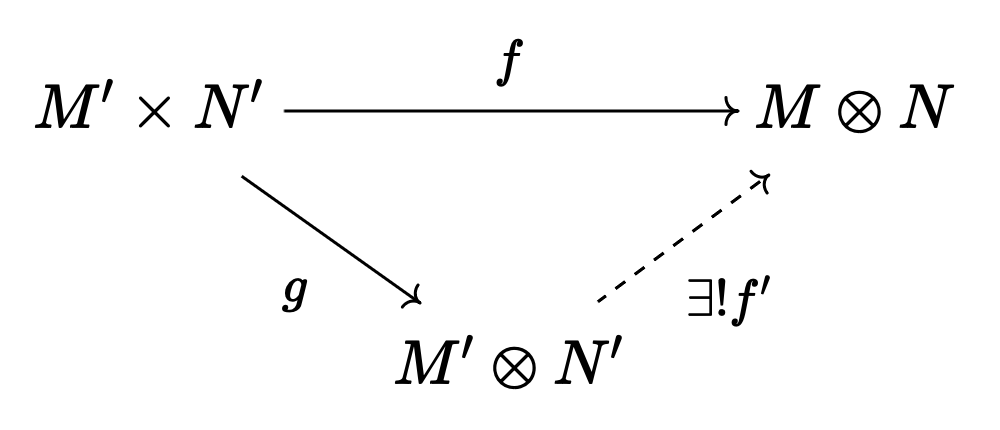
Example. Let , , and let . So we have
Claim that in LHS. In fact, we have the following commutative diagram.
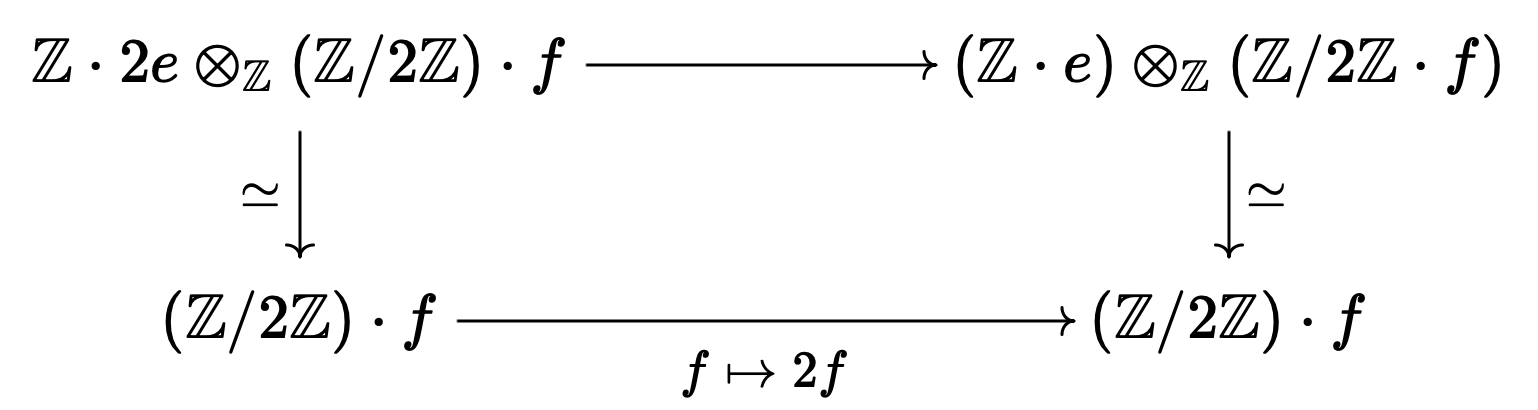
Here we use the isomorphism . Recall that by ^9968ad. So the bottom row being zero map implies the top row is zero map.
Remark. A (practical) guide to tensor product:
- is of form
- get familiar with common operation on
- always keep in mind the expression is NOT unique
- the universal property are not really used in practice like ^9968ad (you should remember and be able to apply ^9968ad)
- common pitfall: and it is not equal to
Bimodule
Definition
Let be rings. We say is an -bimodule, if it is both an -left module and a -right module, and for any , and . Remark that might not exist.
Remark. It has been defined in ^559amp, but I write it again.
Text-Ex. 2.15.
Let be rings. Let be an -module, be a -module and let be a -bimodule. Then is a -module and is an -module, and we have an isomorphism of -bimodule
\begin{proof}
It is easy to check is a -module and is an -module. The proof of isomorphism of -bimodule is similar to ^9968ad, ii).
Fix , define . It is -bilinear and it induces an -linear map .
Define , and it is -bilinear. Son it induces a -linear map . To prove it is isomorphism, it suffices to construct its inverse, which can be done similarly.
\end{proof}
Corollary
Suppose in , with . Then there exists some finitely generated submodule and such that in . Remark that is not injective, see Strange Things about Tensor Product as example.
\begin{proof}
Since in with , there is . Then
Let be the submodule generated by and . Similarly define be the submodule generated by the second coordinates on RHS and . We claim that RHS of in is also an element in .
\end{proof}
Restriction and Extension of Scalars
Definition
Let be a ring homomorphism, and let be a -module. Then we can also regard as an -module, so that, for any and , define . This -module is said to be obtained from via restriction of scalars.
Example. Define and is a vector space over . Then can be regarded as a -module.
Proposition
Let and be a -module as above. Suppose is finitely generated as -module and is a finitely generated -module. Then is also finitely generated as -module.
\begin{proof}
Let and . Then .
\end{proof}
Definition
Let be a ring homomorphism. Since is a -module, we can define . This is an -module, and it is indeed an -bimodule via . We say this -module is obtained via extension of scalars.
Example. Define and . Then , because
- and
- by .
Proposition
Assume be a ring homomorphism and is a finitely generated -module. Then is a finitely generated -module.
\begin{proof}
Since , we have .
\end{proof}
Exactness Property of the Tensor Product
Theorem
Let be -modules, then we have natural isomorphism
\begin{proof}
Take in LHS, and define as follows. For each fixed , the map . It is -linear and so . It is easy to check the map
is -linear.
Conversely, given in RHS. Define
which is -bilinear and it induces .
Finally, check and are inverse each other.
\end{proof}
Example. Recall (See here or here). We claim that . Note that any in LHS is completely determined by . Since , is killed by . That is, for any lift of , we have and so . Therefore, .
Example. Put , and to ^60fa98, then we have
where LHS and RHS .
Proposition
Let be a right exact sequence of -modules. Let be any -module. Then the sequence
is still right exact.
\begin{proof}
Note that it is easy to see is surjective. It remains to check . By ^jj28ws, it suffices to show for any -module ,
is left exact. By ^60fa98, it is equivalent to show
is left exact. By ^jj28ws, we have done.
\end{proof}
Remark.
- is necessary. For example, is exact, but after tensor we get , which is not exact.
- a left does not product similar result. For example, is exact, but after tensor we get is right exact but not left exact.
Definition
We say an -module is a flat -module, if for any exact sequence
the tensor product sequence is still exact.
Examples.
- is not flat by it.
- The -module is a flat -module.
- is flat -module.
Proposition
Let be a -module. TFAE:
- is flat.
- For any short exact sequence , is still short exact.
- For any injective map , is also injective.
- For any injective map with finitely generated, is still injective.
\begin{proof}
i)←>ii) is trivial as each long exact sequence can be split into short exact sequence.
iii)→iv) is easy.
i)=ii)→iii) by considering exact.
iii)→ii) When iii) holds, preserves right exactness. Furthermore, preserves left exactness by ^8m15t3 and so for short exact sequence.
It remains to show iv)→iii). Suppose , that is, . We aim to show . Let . Let be an element in . Remark that we do not know if is also zero, as may not a submodule of by Strange Things about Tensor Product.
^6zw2e4 says that for , there exists finitely generated submodule containing and finitely generated submodule such that in . So in particular, from injective map , we have injective map . Since and are finitely generated, by iv) we have is injective. Note that in , then we have is in . It deduces that in .
\end{proof}
Text-Ex. 2.20.
Let be a ring homomorphism and let be a flat -module. Then is a flat -module. Remark that in general is not flat -module.
\begin{proof}
Let be an injective map of -modules. It remains to show is still injective. But
and then the map is injective by being a flat -module.
\end{proof}
Remark. Let and . But is not flat over .
Algebra and Tensor Product of Algebra
Definition
Given a ring homomorphism , we say is an -algebra. Note that has an -module structure which is compatible with ring struction on , that is, .
Examples.
- Any ring is a -algebra.
- Field extension is a -algebra with .
Definition
Given and , a ring homomorphism is called a homomorphism of -algebra if it is also a -module homomorphism (i). Equivalently, is an -algebra homomorphism iff the following diagram commute (ii).
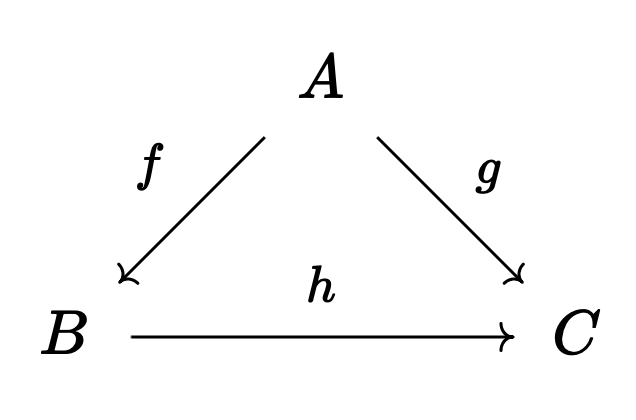
\begin{proof}
i)→ii). ii) means . Note that if i) holds, then
ii)→i) It suffices to show . By
we finish the proof.
\end{proof}
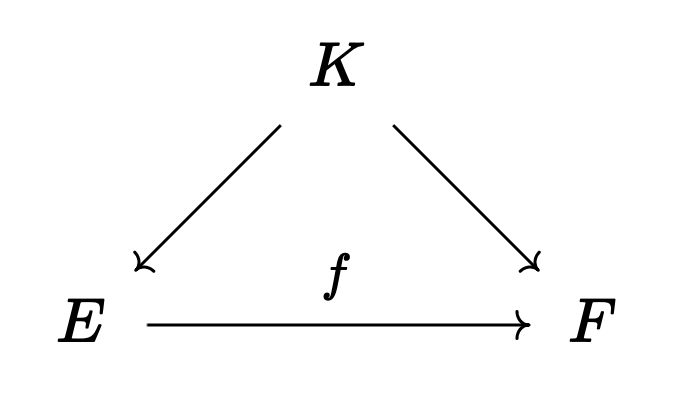
Example. Recall given field extensions and , and are -algebras and is a field homomorphism. is also a homomorphism of -vector spaces iff is a homomorphism between -algebra iff is a homomorphism such that for any iff the diagram commutes.
Definition
- Say is a finite morphism of rings, if is a finitely generated -module. In this case, say is a finite -algebra.
- Say is of finite type, if there exists such that any can be written as a polynomial in with coefficient in . It is equivalent to there exists surjective map . In this case, say is a finitely generated -algebra.
So finite -algebra is a finitely generated -algebra.
Examples.
- is a finite -algebra
- is of finite type
- is of finite type
- is a finite -algebra
Definition
For a ring , we say it is finitely generated if it is finitely generated as -algebra.
Example.
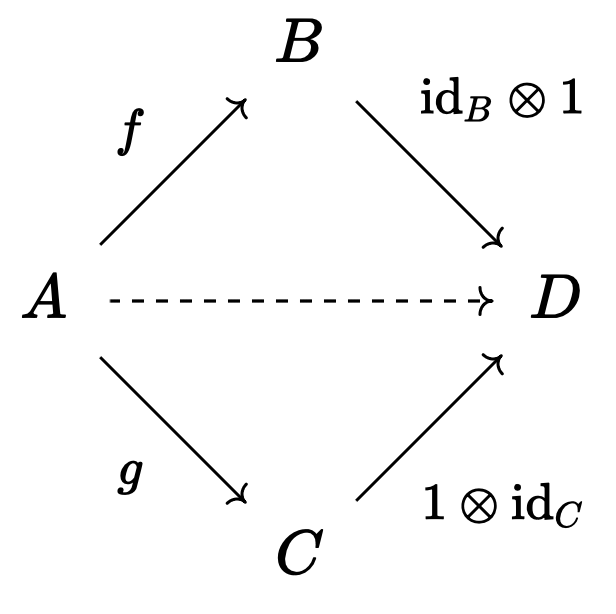
a Construction on Page 31. Let and be two ring homomorphisms. Let . Claim that we can define ring structure on and make it an -algebra.
\begin{proof}
Consider . By ^ml3hwi above, it induces an -linear map
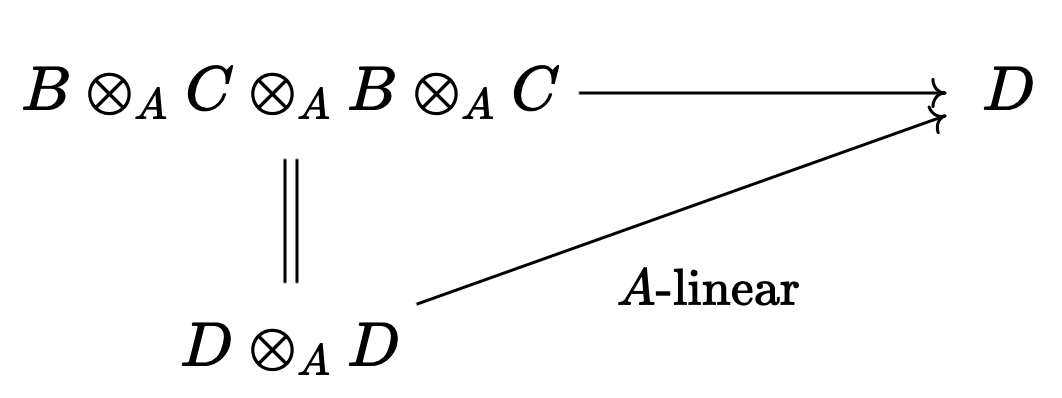
By ^aa5afc, this is the same as an -bilinear map with . One can check this (used as multiplication) is compatible with on , giving a ring structure.
Define by . Note that . It is easy to see it is a homomorphism of rings.
Remark.
-
page 31 of Atiyah is not correct, as is not a ring homomorphism.
-
In fact there is a commutative diagram of ring homomorphism

Example (strange ). Define is not a domain, because
To see the above two elements are nonzero, notice that is a vector space over and
where . Hence is a -dimensional -v.s. with a basis . So the above two elements are nonzero.
Examples.
- . Each element on LHS has a unique expression as are linear vector spaces, then is well-defined.
- . The problem is, is NOT a basis of . “For example”, consider and .
Proposition
Let be an ideal, and let be an -module. Then .
\begin{proof}
Consider short exact sequence . Tensor with and we get a right exact sequence
Recall the notation . It is easy to see (remark that in general is not injective). So we get a short exact sequence . So .
\end{proof}
Remark. This is an example where is not injective. Let , and let . Then and .
a useful fact
Let be an ideal. Let be two -modules, then one have an -module isomorphism
Remark. For general and two -modules and , .
\begin{proof}
Consider
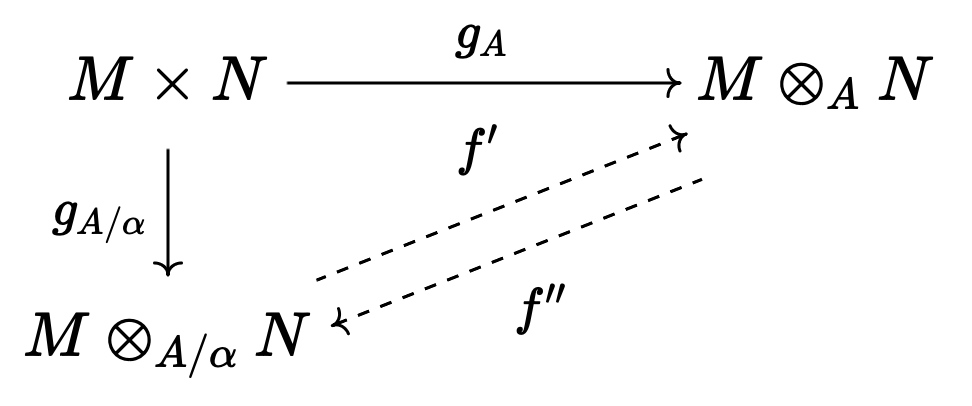
Define , then is -bilinear and there exists such that . Similarly, define , then is -bilinear and there exists such that . So and so .
\end{proof}