16. Let be a flat -algebra. Then the following conditions are equivalent:
- i) for all ideals of .
- ii) is surjective.
- iii) For every maximal ideal of we have (1).
- iv) If is any non-zero -module, then .
- v) For every -module , the mapping of into is injective. (Hint: see here.)
is said to be faithfully flat over .
\begin{proof}
i)→ii) By Proposition 3.16, for any given prime ideal of , yields is a contraction of a prime ideal . So for all , that is, is surjective.
ii)→iii) Assume that there exists such that , then and so . By Proposition 3.16, is not a contraction of any prime and so , contradicting with surjective.
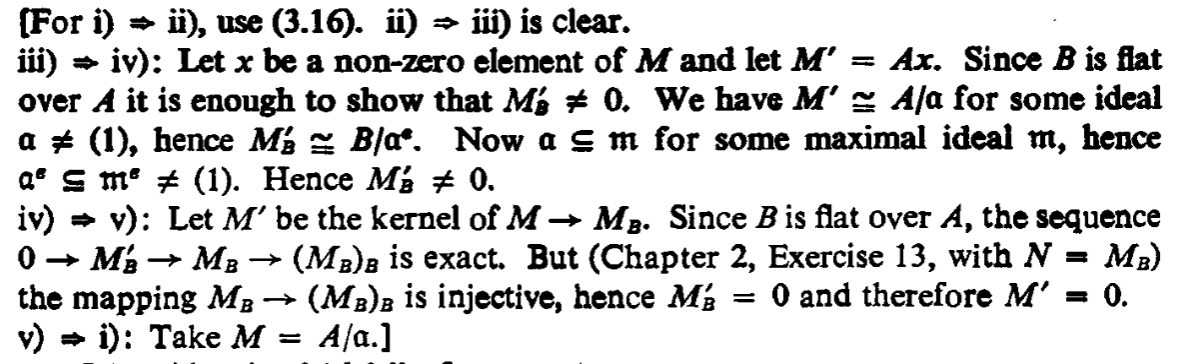
iii)→iv) Let be a non-zero element of and let . Then there is an injective map . Since is flat over , the map is also injective. Thus, it is enough to show that .
Note that there is a natural map
then for some ideal . By Text-Ex. 2.2, we have . If , then . By iii), it deduces and then , which is impossible. Therefore, and so .
iv)→v) Define . Let be the kernel of . Then
is exact. Since is flat, one have
is exact. Take and apply Text-Ex. 2.13, then is injective. Then by exact , we know and so by iv). Therefore, is injective.
v)→i) For any ideal , take and then by v) is injective. If , then and is non-empty. However, by Proposition 1.17, which contradicts with injective.
\end{proof}
22. Let be a ring and a prime ideal of . Then the canonical image of in is equal to the intersection of all the open neighborhoods of in .
\begin{proof}
By Proposition 3.11, there is a - correspondence between prime ideals of and prime ideals of which do not meet . Thus the canonical image of in is the set
Recall that is a set of topological basis of . If is an open neighborhood of , then and and so . Therefore, the intersection of all the open neighborhoods of in is
For any prime ideal , there exists and . It deduces that . Conversely, if , then for any , , which yields . So
Now we finish the proof.
\end{proof}