Presheaf, Sheaf and Sheafification
Definition
Let be a topological space. A presheaf on consists of
- for any open set , is a set;
- for any , there exists ;
such that
- ;
- for , we have .
Remark. We may write for .
Definition
Let and be presheaves on , a map is a collection of maps for each open such that if , then
commutes.
Remark. Let be topological spaces, and let be a continuous map. Then induces a map from to , where . It is not a sheaf map, as they are defined on different topological spaces. However, later we can define "" on .
Definition
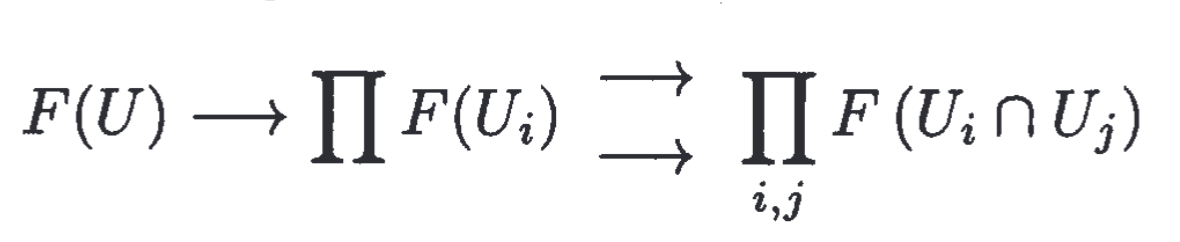
A presheaf is a sheaf if for every covering , the diagram
is exact. That is,
- is injective (if for all , then );
- for any such that for any , then there exists such that .
Examples and Counterexamples.
- Let be a topological space, and let . Then is a sheaf with .
- is a presheaf but not a sheaf. If , and , then there does not exist such that as is unbounded.
- is a presheaf but not a sheaf. Take and , then we can take special such that for all . So is not injective.
Sheafification of a presheaf
For any presheaf , there exists unique sheaf such that
- is a presheaf map;
- for any where is a sheaf, there exists unique such that .
Examples.
- is the sheafification of .
- need verification;
- is injective but not surjective.
- For , .
- is not injective.
Stalks
Let be a presheaf. For any , define the stalk of at
where if there exists such that and .
Example. Define , then the stalk at is
where if there exists such that and . Thus .
Example. Let continuous functions . Then is the set of germs of continuous functions at . It is modulo an equivalence relation: if and agree in a neighborhood of .
Structure Sheaf
For any , if is a group/ring and is a group/ring homomorphism, then is also a group/ring. Note that , and define .
In classical algebraic geometry, one often wants to study functions that behave well under localization, which leads to the concept of a structure sheaf.
structure sheaf
Let be an irreducible algebraic set, and let .
- Let be its field of fractions.
- Since is irreducible, is an integral domain.
- For , define .
- This is a maximal ideal, as it is the kernel of the homomorphism given by .
- Let .
- It is a localization of a ring.
- Recall that .
We have then . Now for a Zariski open set , let
All the are subrings of . If , then ; if we take the inclusion as the restriction map, this defines a sheaf .
Remark. For and , there is with and . Then .
Proposition
Let be an irreducible algebraic set. Define . For , let . Then .
\begin{proof}
Take . For any , and so . Then and .
For any , define and then is an ideal of . If there exists such that , then and . For some and for any , we have and with . Since , we have and . It deduces that and . Then containing and so there exists such that .
\end{proof}
Example. In particular, . Take , and then and . It deduces that
Remarks.
-
If and for all , then , as yields and .
-
, may not be with . However, it is true when by ^9d743b.
-
The stalk of at is . Recall that . Since is a topological basis, by ^9d743b we have
As all restriction maps in our sheaf are injective, it is just .
Proposition
Let be irreducible algebraic sets, and let be a continuous map. The following conditions are equivalent:
- i) is a morphism
- ii) for all
- iii) for all open , and
- iv) for all , and .
\begin{proof}
i) → ii) is easy. Take for ii)→i).
iii)→ii) is trivial by taking , and iv) iii) by the definition of .
ii)→iv) Let . We write with and . By ii), ; hence , since we have .
\end{proof}
Affine Variety
Definition
An affine variety is a topological space plus a sheaf of -valued function on , which is isomorphic to an irreducible algebraic subset of some plus the sheaf , where .
Affine Variety Definitions
- Classical Definition: An Affine Variety is an irreducible closed subset of affine space defined by the vanishing of a set of polynomials.
- Modern Definition: An Affine Variety is a topological space together with a sheaf of -valued functions , which is isomorphic to a classical Affine Variety together with its structure sheaf .
The modern definition adds the structure sheaf to the classical definition. This allows for a more sophisticated study of functions on the variety.
Definition
is called an affine -space, denoted by .
Remark. If there is such that is an affine variety, then
- is a bijective map between topological spaces and ;
- both and induce the isomorphism for all open sets .
By ^dbd10f, is a morphism in the category of affine varieties. However, a bijective morphism in this category may not be an isomorphism.
- It is correct, for example, in the category of compact topological spaces, of Banach spaces, and of complex analytic manifolds.
- In the category of complex manifolds, a bijective holomorphic map is a morphism, and its inverse is also holomorphic by the inverse function theorem. Thus, in this category, bijective morphisms are isomorphisms.
- It is false for the following cases.
- For the category of differentiable manifolds, consider the map , it is not a diffeomorphism because is not smooth at .
- For a field with , define . It is bijective and corresponds to the inclusion map in the pair of rings . Thus, is not an isomorphism since these rings are not equal.
- Let be any algebraically closed field. Define the morphism . The image of this morphism is the irreducible closed curve . The morphism from to is a bijection which corresponds to the inclusion map in the pair of rings . These rings are not equal, so and is not an isomorphism.
Induced Variety Structure
Definition
Let be an affine variety, and let be an irreducible closed subset. Define
Proposition
is an affine variety.
\begin{proof}
Suppose and . For closed irreducible , assume that and then .
It suffices to show . Define and . For any open set and any , can be written as where and . Let , then and as . Now we have proved that .
Conversely, for any and any , there is for some . Then and so .
\end{proof}
Proposition
Let be an affine variety, and let . Then is an affine variety, where .
\begin{proof}
We identify with and define . Since , we define
Thus is an affine algebraic set and can be identified with . Now we aim to show the identification works.
Define , then is a morphism. Since and , we have and . It is easy to check is bijective and is a homeomorphism.
Note that and by ^9d743b there is . Then and so is an isomorphic. Now we finish the proof.
\end{proof}
Check
Although is a distinguished open set, it can be viewed as an affine variety in a higher-dimensional affine space. In this space, is isomorphic to a closed irreducible algebraic set.
Example. Define , then .
\begin{proof}
Let . For any , we claim that for any , where .
If the claim holds, then we can prove that . By claim we have . For any , to show is regular on , it suffices to show for any , where is dimension . If , define and then . For any contains , we have and so with , i.e., . It contradicts with . Therefore, . Now we prove that .
Now it is enough to prove the claim. Take , and assume that . For any such that , there is and so with . However, by regular on being dimension , which is a contradiction. Now we proved the claim.
\end{proof}
Check
It took me a long time to fill in the proof for this example because I had difficulty proving .
The most crucial point is that to prove that elements in are regular on , it suffices to show that they belong to for any by ^436480.
In summary, for an affine variety and its coordinate ring , the following three statements regarding a function defined on are equivalent:
- .
- (That is, is an element of the coordinate ring, representable by a global polynomial defined on the ambient affine space and restricted to ).
- is a global regular function on .
- (That is, , also denoted ).
- For every open subset , the restriction is a regular function on .
(That is, holds for all open sets ).
Remark on Non-Affine Varieties does not hold for non-affine varieties, such as most projective varieties.
This equivalence generally
Example: For the projective line (assuming it is connected and defined over an algebraically closed field), the only global regular functions are the constant functions, i.e., . However, there are many non-constant functions on that are regular on their domains of definition (a proper open subset). For instance, the function defined by is regular on the affine open set , but it is not constant and thus not globally regular on .