Definition
A tableau is called standard if the rows and the columns of are increasing sequences.
In this section, we aim to prove the following theorem. The proof is written here.
Theorem
The set is a basis of Specht module .
We call a sequence with is a composition of , and is called part of . (Compare with partition: composition with .) We say that composition dominates , if for any there is .
Suppose is a tabloid of shape . For each , define as the tabloid formed by all elements in , and define as the composition which is the shape of . Here is an example:

There is a way to order tabloids in the same shape.
Definition
Let and be two tabloids in -shape with the corresponding composition and . We say that dominates , denoted by if for all .
Remark. Not all tabloids can be compared. For example, take
Note that and .
Lemma
If and occurs in a lower row than in , then .
\begin{proof}
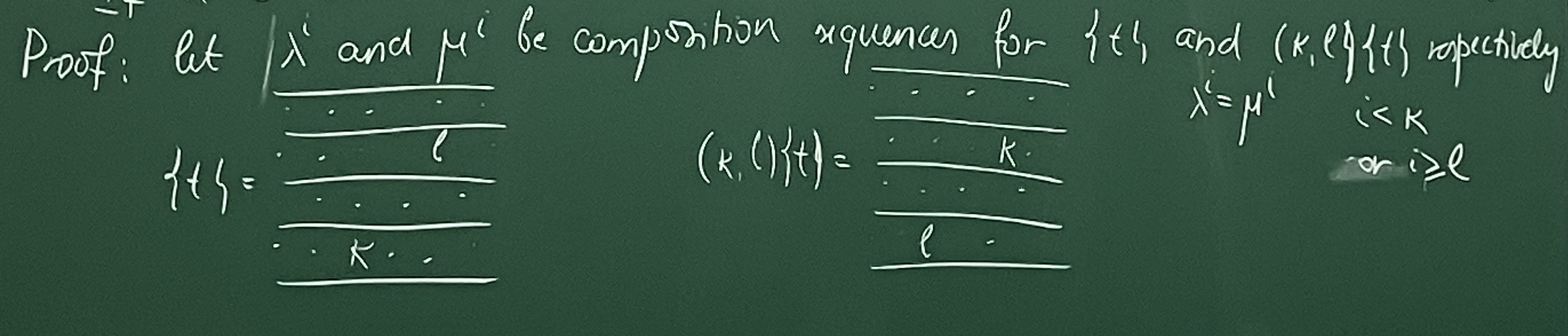
Let and be composition sequences for and , respectively. If , and suppose , is in row , of respectively, then
and so for all . Here is a illustration.
\end{proof}
Corollary
If , we say that appears in if . If is a standard tableau and appears in , then .
\begin{proof}
Write with .
We do induction on number of “inversions” in , that is, the number of pairs such that and are in the same column but is in lower row than . Then for each inversion and thus . Here is an example.
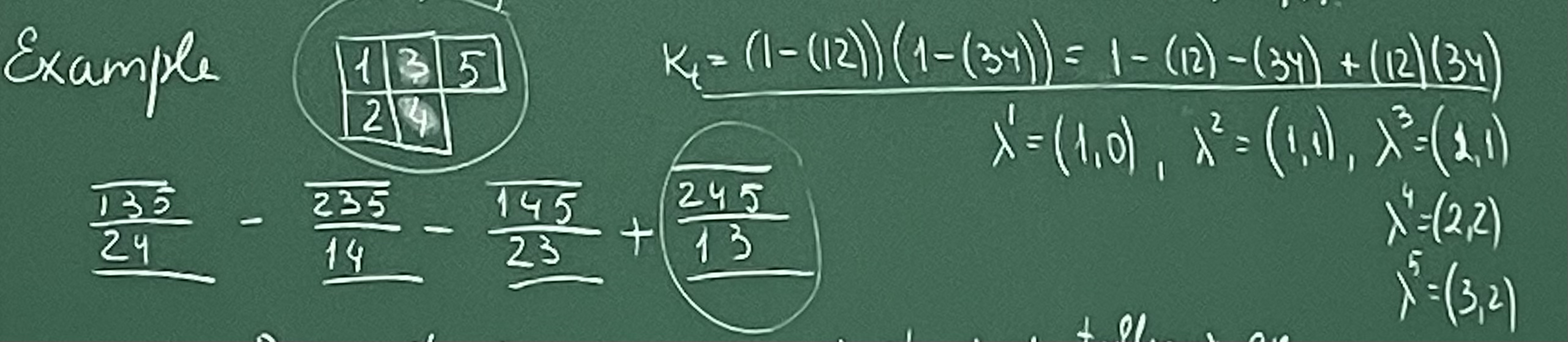
For the last term , and are two inversions. By ^rswrnz, .
\end{proof}
Now we are ready to prove ^030a4e.
\begin{proof}
First we prove that they are linear independent. Suppose , and we label in such way that there is no with . Then by corollary only appears in and so . By induction all , contradiction.
Next we prove that standard polytabloids of shape span . For a polytabloid with tableau , we may assume that column of are increasing by replacing with for some suitable . Then if is not standard, we will find two adjacent elements in one row with . Now we aim to find a linear combination of polytabloids where this row descent is eliminated. This algorithm uses Garnir relations, as the following example shows.
Example
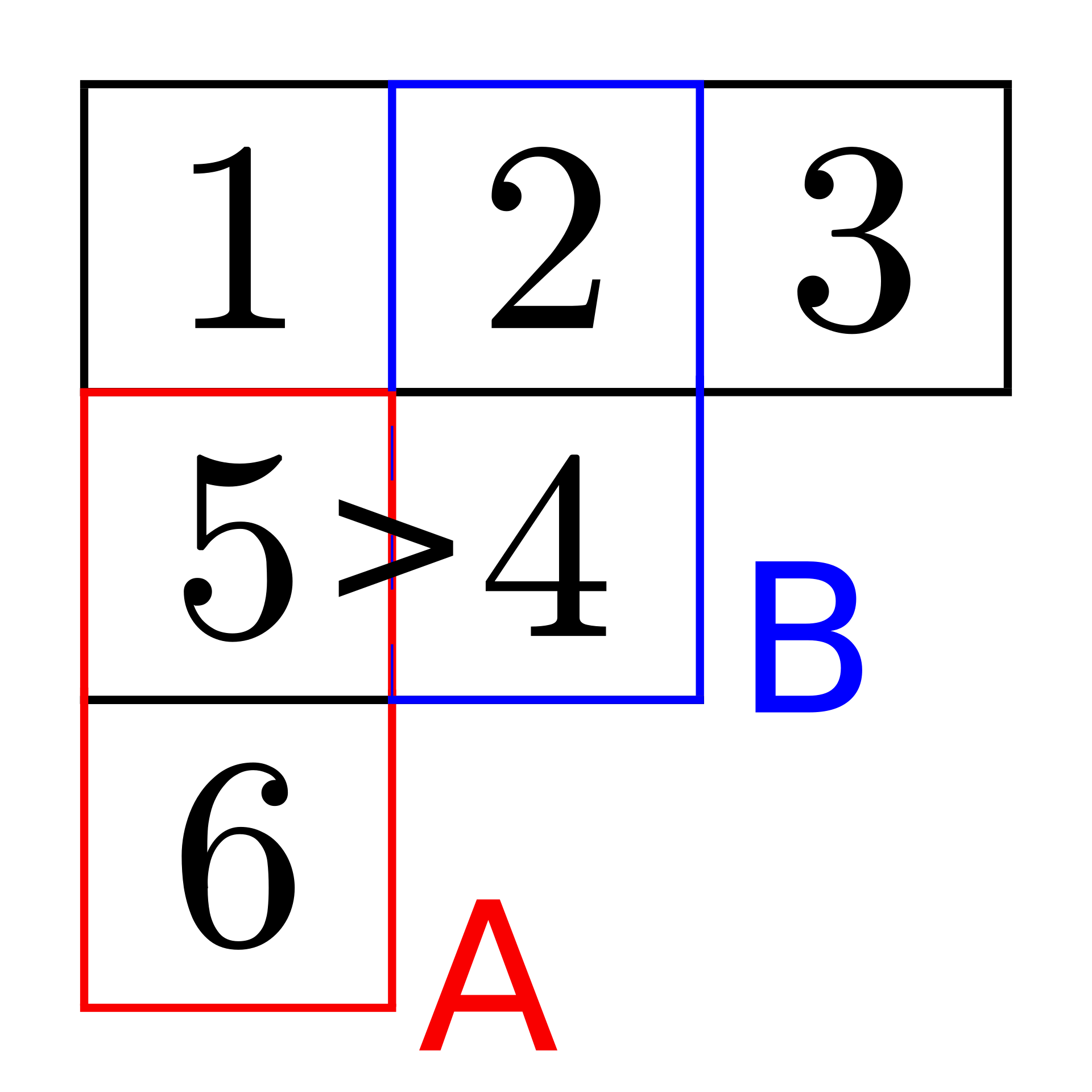
Consider the following Young tableau :
There is a row descent in the second row, so we choose the subsets and as indicated.
Consider all partitions of with and , that is
and they corresponds the following polytabloid
and the Garnir element . One may check and so
Therefore, the row descent in the second row is removed. One can repeatedly apply this procedure to straighten a polytabloid, eventually writing it as a linear combination of standard polytabloids.

With this example, it suffices to show .
Proposition
For a tableau with a row descent and the corresponding sets and , we have .
\begin{proof}
We claim that . Since is greater than the size of column containing , for any there exist which are in the same row of . Then by ^fae9c5, yields that . Since , there is .
Then consider the coset decomposition of . Note that
where . Hence, . For any element , and so . Therefore,
yields that .
\end{proof}
Now we finish the proof of ^030a4e.
\end{proof}
Now we get a basis of Specht module . The corresponding representation of it, is Young natural representation.
Recall that is generated by transpositions , then we denote . For be a polytabloid corresponding to standard tableau, there is
- if and are in the same column, then ;
- if and are in the same row, then will have row descent and then apply Garnir element;
- if and are in different columns and different rows, then is another polytabloid corresponding to standard tableau.
Therefore, each transposition induces a linear transformation on the subspace spanned by s polytabloids corresponding to standard tableaus. We refer to this representation as Young natural representation.
Remark. Every irreducible representation of has integer values, in particular defined over . Hence, all representations are of symmetric type.