Definition
Let be a prime. A -modular system is a triple where is a field of character equipped with a discrete valuation, is the valuation ring of with maximal ideal , and is the residue field of with .
Given a finite group , if both and are splitting for , then we say that is a splitting -modular system for . This happens when contains a primitive th root of unity.
Preliminary
RG-module & kG-module
Lemma
Let be a DVR with maximal ideal and . Let be a finite group.
- If is a simple -module, then .
- The simple -modules are exactly the simple -modules made into -module via the surjection .
- For each -module , . In particular, .
- For each -module, we have .
\begin{proof}
i) Since is a -submodule of and is simple, we know or . As -modules, by Nakayama lemma, so .
ii) Note that and annihilates simple -modules.
iii) If is a maximal submodule of , then is simple. So and . Hence .
iv) Recall that is the intersection of kernels of all morphisms from to simple modules.
\end{proof}
Corollary
Let be a DVR with maximal ideal and . Let be a finite group. Let be finitely generated projective -modules. Then as -modules iff as -modules.
\begin{proof}
One direction is easy. On the other hand, note that yields . Since projective cover is unique, we have .
\end{proof}
Projective kG-module & RG-lattice
Definition
An -module is called an -lattice if it is finitely generated and free as -module.
The key point of the following proposition is, every finitely generated projective -module can be lifted to be an -lattice, and such a lift is unique up to isomorphism and projective.
Proposition
Let be a complete DVR with maximal idea and . Let be a finite group.
For each simple -module , there is a unique indecomposable projective -module that is a projective cover of . It has the form where is a primitive idempotent in with .
The -module is the projective cover of as -modules and is the projective cover of as -modules. Furthermore, is the unique simple quotient of .
Thus for simple -modules and , .
Every finitely generated -module has a projective cover.
Every finitely generated indecomposable projective -module is isomorphic to for some simple .
Every finitely generated projective -module can be lifted to be an -lattice such a lift is unique up to isomorphism and projective.
An -lattice is a projective -module iff is a projective -module.
Projective -module and are isomorphic iff .
\begin{proof}
i) Let be a primitive idempotent with . Let be a primitive idempotent that lifts , then . Set . Since is a lift of , it is indecomposable and projective.
ii) Note that . Thus is the projective cover of . Consider the composition , then we know is a projective cover of .
iii) Let be a finitely generated -module. Then is a finitely generated semisimple -module. Write for simple modules . As is a projective cover of , there exists . By Nakayama lemma, is an essential epimorphism.
iv) Let be a finitely generated projective -module. By iii), there exists a projective cover . Since is projective, there exists such that . Since and are an essential epimorphism, we know is also an essential epimorphism. Furthermore, note that is an injective map by , so is an isomorphism. In particular, if is indecomposable, then .
v) It suffices to prove the statement holds for indecomposable projective -modules, that are isomorphic to for some simple -module . Remark that is the projective cover of and is an -lattice. Now we proved the first statement.
To show uniqueness, suppose is any -lattice for which . Note that and . The projective cover factors as . So is surjective and then .
\end{proof}
FG-module & full RG-lattice
Definition
Let be a PID, and let . For a -lattice , is an -module.
Conversely, if is an -module, a full -lattice in is an -lattice that has an -basis is also an -basis of . In this situation, .
Lemma
Let be a PID, and let . Let be a finitely generated -vector space. Any finitely generated -module that contains an -basis of is a full -lattice in .
\begin{proof}
is a finitely generated and torsion-free -module. Then is a free -module and it has an -basis . Since contains an -basis of . Then span as -space.
One can show are linearly independent, and then we finish the proof.
\end{proof}
Corollary
Let be a PID, and let be a field of fractions. Let be a finitely generated -module. Then there exists an full -lattices of .
\begin{proof}
Let be an -basis of . Consider , which is a finitely generated -submodule of and it is -invariant. Thus is a full -lattice of by ^vnn9oj.
\end{proof}
Brauer-Nesbitt Theorem
Brauer-Nesbitt
Let be a -modular system with , a finite group, and a finite-dimensional -module. Let and be full -lattices in , then , have the same composition factors with the same multiplications as -modules.
\begin{proof}
Observe that is also a full -lattices in . So we can assume that . (If it holds, then apply it to and .)
As -module, and are free of the same rank, and then is a torsion -module. Thus, as an -module, has a composition series. Hence has a composition series as an -module. So it suffices to assume that is maximal in , i.e. is simple. Thus and so . It deduces that
We claim that to show . Define
which is surjective as has kernel . Now we prove the claim, and it remains to show and has the same composition factors with the same multiplications.
\end{proof}
DCE Triangle
decomposition matrix
Let be a splitting -modular system for . The decomposition matrix of is the matrix with
- rows indexed by the simple -modules,
- columns indexed by the simple -modules,
- entries are the number
where is a simple -module, is a simple -module, and is a full -lattices in .
Definition
Let be a finite-dimensional -algebra, where is any field.
Define as the free abelian group with the isomorphism types of simple -modules as a basis, which is called Grothendieck group.
Define as the free abelian group with isomorphism types of indecomposable projective -modules as a basis.
If is a simple -module, then write for the corresponding basis element of . If is a indecomposable projective -module, then write for the corresponding basis element of .
If is an -module with composition factors with multiplications , we write
If is a projective -module with where are indecomposable projective -module. Put
Let with be a splitting -modular system for a finite group . Suppose the valuation of is complete. Notice that
-
-
the number of -regular conjugacy class
-
dce triangle:
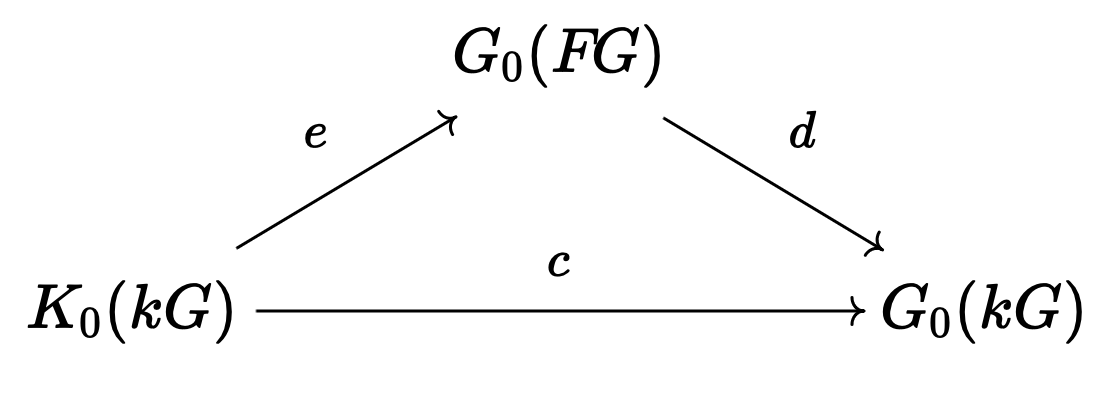
-
If is a indecomposable projective -module, then , where is an -module that lifts .
-
Now is a projective cover of . Define . Remark that for each simple -module , where is the entries of Cartan matrix.
-
If is a simple -module containing a full -lattice . Put . The matrix of is the transpose of decomposition matrix.
Proposition
, i.e., the diagram commutes.
\begin{proof}
Let be an indecomposable projective -module. Then
- for some lifts
Taking to be the full -lattices, its reduction (modulo ) is . Then .
\end{proof}
Proposition
Let be a -modular system. Let be -modules, containing full -lattices , respectively.
- is a full -lattices of
- Suppose further that is projective. Then
\begin{proof}
i) Take -basis and of and , respectively. These are -basis of . Any -morphism can be represented as a matrix over . Regard it as a matrix over , then it represents an -morphism .
Notice that
then by PID, we know is an -lattice.
Let , then . Assume that for all . Let . Then , and so is an -morphism. Thus is a full -lattice in .
ii) Claim that since is projective.
Consider , where . Its kernel is . It is surjective since is projective. Thus .
For the second isomorphism, all morphisms contain in the kernel, so factor as .
\end{proof}
Corollary
Suppose are full -lattices of -modules , and is projective. Then .
Brauer Reciprocity
Let be a splitting -modular system for , where is complete.
- Let be a simple -module and a simple -module containing a full -lattice . The multiplicity of in equals the multiplicity of as a composition factor in .
- The matrix of is , where is the decomposition matrix.
\begin{proof}
i) .
- LHS equals .
- RHS equals .
By splitting, .
\end{proof}
Corollary
Let be the splitting -modular system for , where is complete. Then the Cartan matrix , where is the decomposition matrix. In particular, is a symmetric matrix.