Definition
An epimorphism of modules is called essential if no proper submodule of is mapped surjectively onto by . Equivalently, whenever is a map such that is an epimorphism, then is an epimorphism.
Definition
A projective cover of a module is an essential epimorphism where is projective.
Remark that a projective cover does not always exist. However, if it exists, then it is unique up to isomorphism. In addition, ^mjip80 gives a case where the projective cover exists.
Uniqueness
Proposition
Suppose that is a projective cover of a module and is an epimorphism where is projective. Then so that has the component with respect to the direct sum decomposition and satisfies that the diagram commutes
where is an isomorphism.
If any exists, the projective covers of a module are all isomorphic, by isomorphisms that commute with the essential epimorphism.
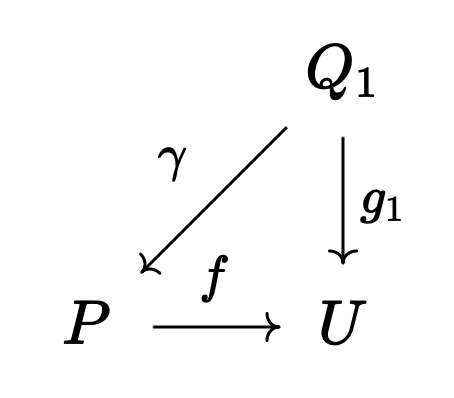
\begin{proof}
Since is projective, there exists such that . Since is projective, there exists such that .
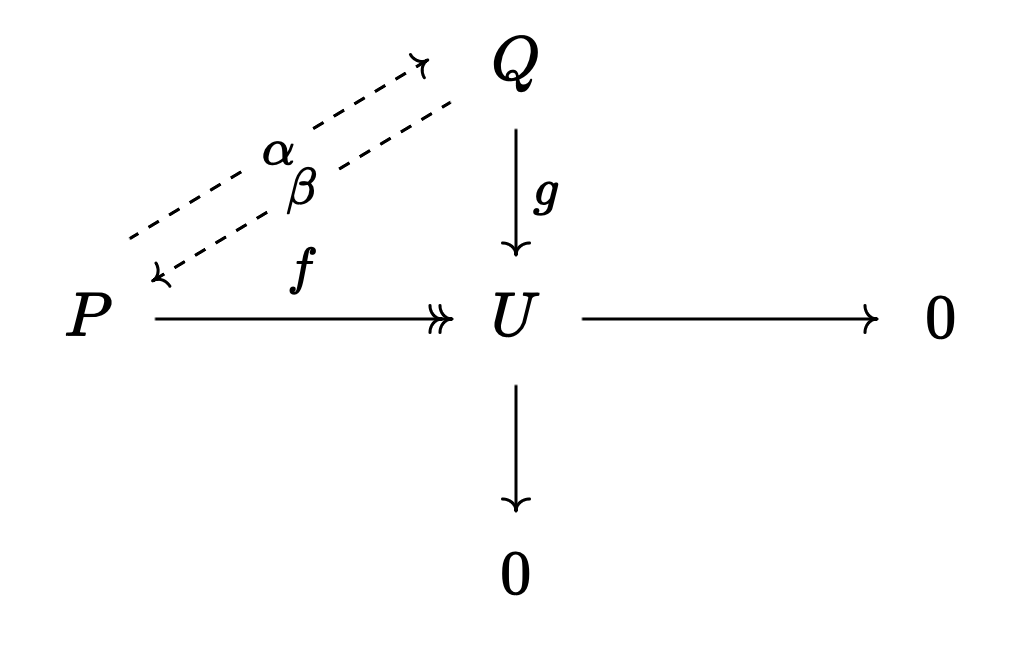
Then yields that is an epimorphism. As is projective, splits and so with . Thus, is what we desire.
Furthermore, assume that and are distinct projective covers, then by the argument above, one can check and . Since is essential, and so .
\end{proof}
Existence
For an Artinian ring , recall that a simple -module always has the projective cover (see here), is semisimple for all -module (see here), and is essential by Nakayama lemma. Then we can prove the following theorem.
Theorem
Let be an Artinian ring, and let be -module. Then has a projective cover.
\begin{proof}
We only prove for finitely generated.
Note that with simple, and then by ^koarlo is a projective cover of , where . Now consider the natural surjection
Since is projective, there exists a lift such that the following diagram commutes by ^9f21f9.
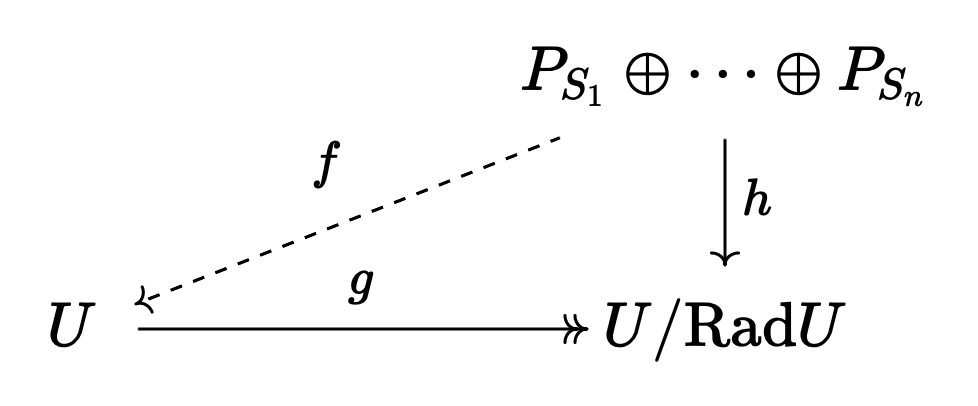
Since is a projective cover and is essential by Nakayama lemma, we conclude that is a projective cover of by ^q7sonb. Therefore, admits a projective cover.
\end{proof}
Remark. In particular, has the same projective cover as .